True Secrets of Freemasonry

Those who become Freemasons only for the sake of finding out the secret of the order, run a very great risk of growing old under the trowel without ever realizing their purpose. Yet there is a secret, but it is so inviolable that it has never been confided or whispered to anyone. Those who stop at the outward crust of things imagine that the secret consists in words, in signs, or that the main point of it is to be found only in reaching the highest degree. This is a mistaken view: the man who guesses the secret of Freemasonry, and to know it you must guess it, reaches that point only through long attendance in the lodges, through deep thinking, comparison, and deduction.

He would not trust that secret to his best friend in Freemasonry, because he is aware that if his friend has not found it out, he could not make any use of it after it had been whispered in his ear. No, he keeps his peace, and the secret remains a secret.

Giovanni Giacomo Casanova, Memoirs, Volume 2a, Paris, p. 33

Sunday, October 14, 2007

Of Masonic Regularity

No single issue is more divisive than that of the Regularity of a lodge. If you are a member of a regular Grand Lodge, you have millions of brothers around the world, and tens of thousands of lodges will open their doors to you. As a regular Mason, you know that your masonry can trace its roots back to the Premiere Grand Lodge of England and that you are heir to a rich heritage of Masonic history, tradition and learning.

Defining the Terms

Regular: Regularity is a constitutional mechanism whereby Grand Lodges or Grand Orients give one another mutual recognition. This recognition allows formal interaction at the Grand Lodge level, and gives individual Freemasons the opportunity to attend meetings at Lodges in other recognized jurisdictions.

Irregular: This is a description of practice. For instance, a regular lodge can confer a degree in an irregular manner: George Washington was raised as a master Mason before he was 21 years old, a practice that, at the time, was considered irregular. This does not change that he was a regular Mason.

Clandestine: A clandestine lodge is one that pretends to be Masonic but is without a warrant, dispensation, or charter from a regular/recognized grand lodge. Mackey (History of Freemasonry) states: “The (Anderson) Constitutions declare, Section 8, that where a number of Freemasons shall take upon themselves to form a Lodge without a Grand Master’s Warrant, the regular Lodges are not to countenance them nor own them are fair brethren, and duly formed. In other words, Lodge formed without a Warrant from the Grand Master (we now say Grand Lodge) is “clandestine,” and so a “clandestine Masons” is one made in a Lodge without a Warrant.”

Recognize: When One Grand Lodge recognizes another, it acknowledges its Masonic regularity, authority, and territorial integrity. Such recognition, in order to be effectual, must be mutual. When such a recognition is finally given by a more senior Grand Lodge to a Junior Grand Lodge, (it is always the Junior Grand Lodge that applies for recognition) the two Grand Lodges are said to be in amity, mutual intercourse, or fraternal relations. The processes whereby one Grand Lodge recognizes another often involve, and are sometimes preceded by a settlement of prior differences, if any. The most usual method of assessing the regularity of an unrecognized Grand Lodge petitioning for recognition involves the seeking out of the opinions of other Grand Lodges already recognized. (Henderson, op cit. p. 15)

Amity: Grand Lodges and Grand Orients that afford mutual recognition and allow intervisitation are said to be in amity. As far as the UGLE is concerned, regularity is predicated upon a number of landmarks, set down in the UGLE Constitution and the Constitutions of those Grand Lodges with which they are in amity. Even within this definition, there are some variations with the quantity and content of the Landmarks from jurisdiction to jurisdiction.

There are two major branches of Freemasonry which consider their Lodges to be "regular", and both branches consider the other to be "irregular". The first, oldest and significantly largest of these two groups are those Grand Lodges in Amity with the United Grand Lodge of England. The other group are those Orients and Grand Lodges in amity with the Grand de France. The UGLE branch is commonly referred to as being "regular" (or "Mainstream") Masonry, while those Grand Lodges and Grand Orients in amity with GOdF are commonly referred to "liberal" or "irregular" Masonry.

For most regular, Mainstream Masons, there is little or no thought given to clandestine masonry, what it is, what it does, what it looks like, who are its members. They are not demonized to any extent, though they are not, for the most part, considered to be “real” masons. On the rare occasion that clandestine Masonry is considered at all, it is to ensure that the lodge you are visiting is in the Lodges Masonic publication, or, if you have met a brother on the street, to ensure his lodge is in that book before you invite him to your lodge for a degree.

So, Why Regularity?

Regularity is the tool we have devised to keep Masonry… well, Masonic. With anything in life, one must have a definition. In the case of Freemasonry, we have a definition of what is, and what isn’t, Masonic. In Freemasonry, what is Masonic is defined by the use of Regularity, recognition, and amity.

A Google search will show that there are many groups around the world that style themselves as Masonic, from outright frauds, such as the American Masonic Federation founded by Matthew McBlain Thomson upon the premise of selling degrees, to the United Grand Lodge of England, and hundreds of variations in between. Pretenders to masonry are groups like the Regular Grand Lodge of England, and the Grand Lodge of All England at York and of course, the American Masonic Federation noted above.

Yet, in between those extremes, the entirely irregular and clandestine to the very definition of regularity are orients, grand lodges and obediences that have as their members men, and yes, women, who name themselves Masons and brothers. What is a non Mason, no less a regular Mason to make of this spectrum of masonry that confronts them? How is one to decide, and does one need to decide?

We are told by irregular and clandestine Masons that the definition does not matter. Of course that is the position they would take, they must, or they would have to quit their group and join a regular lodge. At the other extreme you have the regular masons, who stand on the ground that the definition is essential, and they must take this position as well.

There are endless papers written on regularity, the Grand Lodges that participate in the system have committees and rules that define regularity. These seem to be pretty cut and dried things, but they aren’t, and therein lies the fault of the whole system. Of course, any system devised by man has faults.

In an earlier blog entry I wrote about the difference between regularity and recognition. In that article, my point was that, while the grand lodges and grand orients need to wrangle over the issue of regularity and amity and recognition, brothers, members of those orients, do not… as long as it does not entail Masonic communication.

Masonic communication, or as it is alternately called, Masonic intercourse, involves any type of communication involving sharing the secrets of masonry. Primarily, that is sitting in a tyled lodge session, which is any type of Masonic meeting where the general public is NOT allowed, or where the qualification for attendance is being a Mason.

For most Masons in the United States, regularity is not an issue. Rare is the case where you will meet a member of a non regular obedience in your travels. In other countries, for instance, in the United Kingdom or France, the probability rises that in your life you will meet at least one female Mason, or a man that is a member of a co-ed lodge. Try not to back away in horror if you do, as they are, for the most part, as is true with all regular masons, good brothers.

That is the rub, and the cause of much… hurt feelings. As a member of the Grand Lodge of California (just to reinforce, I am NOT speaking for the GLoCA here, only for ME), it is my understanding that I cannot hold Masonic intercourse with a clandestine Mason. My grand lodge does not recognize him/her as a Mason, however, on a personal level, its not about what the Grand Lodge does or says. Its about me, and the other Mason.

When I meet a Mason, it is not about whether they are regular. My first reaction is not to ask if they are a member of a regular grand lodge, that doesn’t even come up… unless they ask me to visit their lodge. THEN and only then, do I need to consider if I can do so legally and within my obligation.

Yet, brothers from lodges that are not recognized as regular do have a problem with the whole issue of regularity. Those in co-ed lodges are very interested in getting my grand lodge to recognize them and allow intervisitation, or at least allow the members to chose to attend a co-ed lodge. The question that has to be asked is: Why should the grand lodge do so?

The assumption being made, by the co-ed Mason, is that regular masons want to attend their sessions, that regular masons have an overwhelming curiosity about their sessions. The truth couldn’t be further from the truth, but it is hard to communicate that to our brethren in the co-ed obedience. The other, often unstated but clearly felt opinion by our brethren in the co-ed community is that the grand lodge fears them, that if they could somehow convince their regular brethren to visit that the regular brethren would be so smitten by what they see and experience that they would dimit and join the co-ed lodge on the spot.

This seems a pretty arrogant, though understandable conceit. The co-ed brethren are also, at least this has what has been communicated to me so often I assume it is true, of the opinion that many regular masons would leave the regular grand lodges if they just, somehow, knew that co-ed masonry existed in the world for them. Again, it’s an arrogant thing for them to feel, though as noted before, it is an understandable conceit.

As brothers, we can tie ourselves in knots over the regular/clandestine issue, or we can recognize that regularity is only a tool, one that has served the grand lodges and freemasonry well for almost 300 years. It is a tool for GRAND LODGES, however, and is not a tool of a master mason. We have other tools at our disposal, one of which is the level.

Let us, as brothers then, apply the Level to our non tyled meetings. If a person claims to be a Mason, let us, in the spirit of brotherly love, accept the claim on its face and grant them the respect they are due as masons. Leave the issues of regularity to the grand lodges to wrangle over.

May the blessings of heaven rest upon us and all regular masons, may brotherly love prevail, and evey moral and social virtue, cement us!

Saturday, October 13, 2007

What's Wrong with this Picture??

So, what is wrong with this picture. Its a white and blue map of the United States. It’s not a Democrat/Republican white state blue state map. No, this map shows a deeper divide, one that should not exist among Masons. The blue states in this map represent states where the Mainstream Grand Lodges have at least recognized that Prince Hall Masonry is regular masonry. Most of these states have also instituted some kind of mutual intervisitation.

The ritual of the Grand Lodge of California, in the first degree, speaking of Brotherly Love states:
By the exercise of brotherly love, we are taught to regard the whole human species as one family, the high and low, the rich and the poor, who, as created by one almighty parent and inhabitants of the same planet, are to aid, support and protect each other. On this principle, Masonry unites men of every country, sect and opinion, and causes true friendship to exist among those who might otherwise remain at a perpetual distance.
This is pretty typical of the teaching in all grand lodges, and that is what makes the map above so wrong. You see, the states in red are those states that do not recognized that Prince Hall Masonry is FULLY REGULAR MASONRY. In some cases, for instance North Carolina, the issue has come up at their Grand Communication and received a majority vote, but has yet to receive the supermajority that Masonic tradition requires for changes to be implemented.

It is not the intention of the author to hold any one Grand Lodge, any brother, or any group of men up to ridicule, but to question a status that is simply unmasonic and untenable in this day and age. One of the Grand Lodges that, as of this writing, December 10, 2006, still do not recognize the legitimacy of Prince Hall Masonry stated, as recently as 1990 and upheld this in 1991:
… Grand Lodge adopted a resolution that included: "...the Grand Lodge of xxx ... has always considered ... Prince Hall affiliate, to be totally irregular and clandestine, having absolutely no Masonic authority, and the members thereof not to be Masons ... the Grand Lodge of xxx ... most strongly disapprove and condemn in the strongest terms available that action of any other Grand Lodge that may hereafter extend fraternal recognition to any Prince Hall affiliate organization at any time and anywhere located ... any contact or communication whatsoever between a xxx Mason ... and any Lodge under the jurisdiction of any Grand Lodge that does now or may hereafter make any fraternal recognition of any Prince Hall affiliate organization, or between a member of any Lodge under the jurisdiction of such a Grand Lodge ... shall be cleared through the ... Grand Secretary of the Grand Lodge of xxx ... and approved by the Grand Master of Masons in xxx, on a case-by-case basis."
So, you are a Mason as long as you are white… according to this Grand Lodge. Some of these Grand Lodges make the, weak, argument that Prince Hall is not regular Masonry because of its provenance. However, a cursory, or in-depth review of the facts of the matter show the Prince Hall Grand Lodges to predate the antecedents of most existing grand lodges today, AND their original charter was issued by the Grand Lodge of England, a charter still on display at the Most Worshipful Prince Hall Grand Lodge of Massachusetts once per year.

Then, as we look at the map, we see among the states that do not recognize the legitimacy of the Prince Hall Masonry to be many of those that were members of the Confederacy, where a war was fought, in part, to end slavery. Is this a coincidence? This author will not go so far as to stipulate cause and effect, but a brother has to wonder why all the Grand Lodges of those states, including most recently (this year) the Grand Lodge of Texas, recognize the legitimacy of Prince Hall Masonry, and only the southern states, do not.

This situation needs to be remedied, but how can it be fixed from outside, and more importantly, should it? Each grand lodge is sovereign unto itself. This was settled in the late 1700’s when Wr. George Washington was offered the position of Grand Master of the United Grand Lodge of the United States, and rejected the idea. The whole concept of a single, overarching United Grand Lodge of the United States died, though it is occasionally revisited, never very seriously. As American’s, we value our independence.

The whole idea of territorial sovereignty is a new one, created, it seems, out of whole cloth. The rationale for it was to deal with Prince Hall Lodges. It gave the “Mainstream” grand lodge a way to consider a Prince Hall Lodge as clandestine and irregular for violating its territorial sovereignty. This left African American men on the horns of a dilemma: They could not join a mainstream lodge because of racism, but if they joined a “black” lodge, they would be treated as clandestine and irregular, that is, not recognized as regular Masons, by their brother Masons. Their choice was one of: Give up Freemasonry or be an “irregular” Mason. Tough choice. Thankfully, many men chose to be considered irregular and to pursue Freemasonry anyway.

Territorial Sovereignty is ingrained in freemasonry today, at least in the United States, and it is unlikely that it can be addressed simply or easily. There is, however, a recent example of other grand lodges influencing the behavior of another grand lodge using recognition.

Strangely enough, this issue comes from the recognition of the Regularity of the Grand Lodge of France (GLdF) by the Grand Lodge of Minnesota. The GLdF is considered clandestine because they have mixed member lodges, women’s lodges, and do not require a profession of a belief in a deity to become a Mason. Almost immediately upon recognizing the regularity of the GLdF, United States Grand Lodges began withdrawing their recognition of the Grand Lodge of Minnesota.

As Wr. Tim Bryce notes in Recognizing Prince Hall Masonry: To Be or Not To Be?:
…A few years ago the Grand Lodge of Minnesota created a stir in the fraternity when it recognized the GLdF which was considered clandestine by many grand jurisdictions. Consequently, many jurisdictions rescinded their recognition of the Grand Lodge of Minnesota until they finally revoked recognition of France. Using this same logic, if the Dixie jurisdictions truly consider Prince Hall Masonry as clandestine, they should revoke recognition of all grand jurisdictions who recognize Prince Hall (including the UGLE). Failure to do so is hypocrisy. This of course won't happen as the Dixie jurisdictions would face isolation in a remarkably similar fashion as the southern states did in the American Civil War.
If any grand lodge in the United States were to remove its requirement that a candidate acknowledge a faith in god, or allow women as members, the other 50 grand lodges in the United States (AT LEAST) would withdraw their recognition and declare them to be clandestine and irregular in their practice before the ink on the declaration had time to dry. That being the case, and seeing as the use of recognition DOES work, and keeping in mind that we are to WHISPER good counsel and thereby seek to bring about a reformation, perhaps something along the following lines might be offered:

At the Grand Master’s Conference on Regularity, the following resolution might be offered:
Resolved: That Prince Hall Masonry is regular Masonry in all respects, and Resolved: That the exercise of brotherly love requires that we extend the Masonic hand of friendship to all regular brothers;

Be it resolved that all Grand Lodges, whithersoever dispersed around the globe that two years from the date of this resolution that any grand lodge that has not extended and amended their constitutions, codes and rules as necessary to recognize Prince Hall Masonry as regular in ALL respects shall have its intervisitation rights withdrawn.

Be it further resolved that all Grand Lodges, whithersoever
dispersed around the globe that three years from the date of this resolution that any grand lodge that has not extended and amended their constitutions, codes and rules as necessary to recognize Prince Hall Masonry as regular in ALL respects shall have their recognition withdrawn entirely and that/those grand lodges deemed clandestine and irregular.

Be if further resolved that all Grand Lodges, whithersoever dispersed around the globe that four years from the date of this resolution that any grand lodge that has not extended and amended their constitutions, codes and rules as necessary to recognize Prince Hall Masonry as regular in ALL respects will have its lodges offered a new charter under this grand lodge and all members healed and action taken to ensure that good men of color are offered the ability to join the lodge by vacating the use of the SECRET ballot for a period of five years.
This resolution and practice would give the brothers of a grand lodge that does not recognize the regularity of Prince Hall Masonry four years to make the necessary changes so they can be considered regular. As has been noted before: “All it takes for evil to succeed is for men of good will to do NOTHING.” It is time Freemasons stood up and said in a loud and clear voice, NO MORE.

There may be brothers in these grand lodges that have not taken a stand against this practice of ignoring our Prince Hall brothers because they do not know about it, or because there are other issues before them, or because it does not affect them. Its time that we let them know about the issue, that we made it an issue before them, and that we make it affect them. If a man rejects a brother Mason because of the color of his skin, we must take the time to whisper good counsel in his ear.

Its time we stopped waiting on each other. Some GLs have stated they wanted to wait for the Prince Hall Grand Lodge to ASK for recognition. That should not be a condition, as brothers, we should extend unilaterally the hand of friendship. The whole map should be blue, for we are either all brothers before god, or none of us.

By the exercise of brotherly love, the very least we can do is extend our hand to our brothers.

By an extreme coincidence, the Burning Taper published a similar comment today. Please take a moment to read my brother's comment at the Burning Taper.

May the blessing of heaven rest upon us and all regular masons, may brotherly love prevail, and every moral and social virtue, cement us.

Friday, October 12, 2007

Guarding The West Gate


What is it to guard the West Gate? We are told, as entered apprentices, and as Masters, that we should never recommend a man to a participation in our degrees unless we feel that by a similar fidelity he would bring honor and respect to our ancient and honorable fraternity.

For the past few years, decades even, the fraternity seems to have shirked that duty, or taken it less… seriously than in times past. There have even been grand lodges that have instituted one day conferrals, where a profane might be taken, through watching the performance of some plays, to the 32nd degree in a single day.

This seems to have come about through a series of slow changes, each seemingly innocuous on its own, but as usual, taken in concert, have reduced our vigilance. Then there is the concern for the decreasing numbers, which seems to have been taken as a justification for allowing quantity rather than quality through the gates.

The purpose of Freemasonry was never to admit every man into the fraternity! The purpose was to take men who were already upstanding, good men, and through the principles of the fraternity, make them in to better men. It was never to take every man and reform them into adequate men… yet in the name of numbers, we seem to have lost sight of that goal.

This may sound elitist, so lets take a look at the definition of elitist. Merriam-Webster defines it as:

Main Entry: elit•ism
1 : leadership or rule by an elite
2 : the selectivity of the elite; especially : SNOBBERY 1 (elitism in choosing new members
3 : consciousness of being or belonging to an elite

Main Entry: elite
1 a singular or plural in construction : the choice part : CREAM (the elite of the entertainment world) b singular or plural in construction : the best of a class (superachievers who dominate the computer elite -- Marilyn Chase) c singular or plural in construction : the socially superior part of society (how the elite live -- A P World) (how the F.-speaking elite ... was changing -- Economist) d : a group of persons who by virtue of position or education exercise much power or influence (members of the ruling elite) (the intellectual elites of the country) e : a member of such an elite -- usually used in plural (the elites ..., pursuing their studies in Europe -- Robert Wernick)

The definition of Elite and by extension, elitist seems to indicate that Masons are elitists only in the sense we only select, or, rather, allow, only the best, most honorable men into the fraternity. Since our goal is to take GOOD MEN, and make them better men, we have to ask: Is that necessarily a bad thing?

Masonry, as all Masons know, is a group of good men, dedicated to god, seeking to be better men through fellowship with other good men, holding a higher level of morality than society in general. If we claim a higher ground, that is, we claim to be a fraternity of good men, how exactly do we determine that, and how do we define it?

1) A belief in god, however the candidate knows Him.
2) That the candidate be a free man
3) That the candidate be free born (not born into slavery).
3) That the candidate be under the tongue of good report and come well recommended... ie, that he is a moral man.

Ok, the first is pretty straightforward. Most regular grand lodges require a profession of faith and no further inquiry, and the second is fairly self evident; the manner of dress in the ritual puts a fine point on that observation. Since there is no longer any slavery, number three is pretty much a given and a traditional carryover.

The fourth, now, that is the one that requires examination and is the one that most likely will define what watching the West Gate is all about. We know what it is to be under the tongue of good report… a moral, upright, level headed, honorable man with integrity, right?

The issue, then, is morality... does a man come to us under the tongue of good report, and does he come well recommended? The first step is the requirement that two brothers recommend the petitioner for the degrees. As I am a member of the Grand Lodge of California, F&AM, I will speak to my understanding of the rules of that Grand Lodge. Your Grand Lodge rules may vary.

The Petition of the Grand Lodge of California asks that you know that candidate for at least a year before a brother sign a petition. In practice, this is rarely the case, and of course, this is an incremental change that has contributed to the problem.

In the past, we lived within 8 miles of where we were born, and chances are, brothers knew petitioners for many years in the community. Today, that is no longer the case, with men traveling thirty miles or more just to get to work, and our extreme mobility. A man can express interest in joining, and after a few hours talking with him, a brother will be willing to sign as a recommender.

Then the petition is read and accepted, and the master appoints a secret investigative committee, who is charged by the master to look into the character of the petitioner. As an aid in that effort, the Grand Lodge helpfully provides a list of questions that the candidate must be asked. This is a good step, unfortunately, it appears that the investigative committeemen often ask only the questions on the list.

The reason the committeeman often asks only those questions on the list is twofold. The first is because the questions are… to a certain degree, embarrassing. One of the questions we ask is if the petitioner makes enough money to support his family, and another if he has sufficient insurance. I understand the reason for the question, but these are difficult questions to ask someone the committeeman has only known for ten minutes. It does not exactly lead to ongoing general conversation.

The second reason is the committeeman is often untrained for this job on any level, other than by being a good man and a brother. He may have been chosen because the master knows he will fulfill the task, or hopes he will, or because he has done so in the past.

The committeeman often does little more than ask these questions, fill in a sheet and turn it in to the master with a recommendation for membership or a non recommendation. Basic investigative methods aren’t even known often, to the committeeman, so the references aren’t usually called.

Nor are the references asked for other names that may know the candidate so those people may be called. Any investigator should know that the best references are the ones on the petition, and that the true picture of the candidate will come from the secondary or tertiary references. Sometimes, the candidate is interviewed by phone, not even face to face.

Then there is an awesome tool at our fingertips that few of us even consider: The Internet.

I have been on many investigative committees, and one thing I always do is look the candidate up on Google, full name, first name, initial and last name, initial and last name and so on. Until recently, I also checked the public criminal records as well. Its amazing what can be found on the internet.

So, regardless of how well, or how poorly the committeemen do their job, and they can hardly be criticized for how they do their job, they have no training at all, they make a recommendation. If at lest two of the three committeemen make a positive recommendation, the lodge ballots on the petition. If the master does not get at least two recommendations, the petition is held over for another month.

Then of course, there is the ballot box, where one black cube eliminates a candidate. How can you rationally ballot on someone you do not know? So what we do is vote based on the recommendation of the investigative committee. The same committee that is often doing the minimum to carry out an investigation is the basis upon which the lodge makes the decision to initiate a candidate.

So, through a series of simple changes, each made to make it easier to qualify a candidate, we are not watching the west gate, and some men who should never have made it into the lodge are being raised as master masons. Of course, some are caught during the degrees, and not passed or raised as a result… their degrees just never get scheduled and they eventually go away.

I think there are a few things we can do to fix this problem, but they are going to be difficult. First, we need to decide that a man must be known by his top line signers at least three months, by attending public lodge functions or by working with him, or community meetings or… whatever. They should be known before they are allowed to face the investigating committee.

The members of the investigation committee should have some training, at the very least, in how to conduct an investigation. A process should be defined, and at least one of the committeemen should look the man up on the internet, and preferably, the lodge should invest $35 in having a private investigator do a basic background check.

The candidate should at the very least, be introduced by his top line signer to the brethren before a ballot is taken, and the brothers should be encouraged to meet and talk to the candidate prior to a ballot. However, there is no way to eliminate the ballot box, it is a tradition. We might want to consider whether one black cube is enough to disqualify a man. Perhaps at least two for a second ballot and three to disqualify might be a good step.

We must guard the West Gate better, or we can become little more than Rotary with Regalia.
May the blessing of heaven rest upon us and all regular masons, may brotherly love prevail, and every moral and social virtue, cement us.

Thursday, October 11, 2007

Tools of a Mason


As an Entered Apprentice, we are presented the working tools of that degree; the 24” gauge and the common gavel. We are told the 24” gauge reminds us there is a time for everything, and the common gavel is to be used, symbolically it is hoped, to remove the rough and superfluous parts of our rough ashlars, by removing the vices and superfluities of life.

As Fellowcrafts, we are presented with the square, the level, and the plumb, reminding us to square our actions by the square of virtue, to walk uprightly in our several stations before g-d and man, and by the level, that we are traveling upon that level of time toward that undiscovered country.

As Masters, we are presented with the Trowel, to use to spread the cement of brotherly love and affection.

These are the working tools as presented in the State of California, though in other jurisdictions there may also be presented the pencil and the chisel. As speculative Masons, we are taught to make use of these tools for more noble and glorious purposes than our operative early brothers did, the erection of a spiritual house, a house not made with hands, eternal in the heavens.

In this vein, we are presented with a rough ashlar and with a perfect ashlar. The rough ashlar represents a stone as taken from the quarry, in its rough and “natural” state, before being prepared for the architect’s use. This ashlar represents the individual brother, who, through the use of the tools of Freemasonry, he is to work at smoothing.

Of course, we are to add that stone, as time passes, perfecting the walls through using the tools of the Fellowcraft, leveling our walls so they are plumb and square. Of course, we use the trowel of the master to spread the cement with unites these stone into one common mass.

This is the great work on which we are embarked. And yet… there seems to be something missing. Of course, we have dropped the chisel, which is used with the common gavel to shape the ashlar in favor of simply the common gavel, with its wedge shaped head to chip off the rough and superfluous parts of the stone.

What then, of the perpend ashlar, or what is called the broached thurnel? In early masonry, there did not appear to be a perfect ashlar, and certainly not in the first degree, where it does not make sense to appear. In the first degree, the candidate is taught to begin the work, not finish it, because the candidate in the first degree is the rough ashlar.

The rough Ashlar and the Trestleboard seem to have been symbols in Ancient Craft Masonry at least from the beginning of the Grand Lodge period (1717). They are illustrated on the earliest of the old tracing-boards which have come down to us. Just when or how the Perfect Ashlar came into our symbolism is another matter, and not as simple as it appears. In 1731 one Samuel Prichard, who denominated himself as a “Life Member of a Constituted Lodge” wrote and published “Masonry Dissected,” the first of a long series of exposes of Freemasonry. In it is this curious dialogue, purporting to be held between the Entered Apprentice during his initiation, and some initiating officer:

Q. “Have you any Jewels in your Lodge?”

A. “Yes.”

Q.“How Many?”

A.“Six, three movable and three immovable.”

Q.“What are the movable Jewels?”

A.“Square, Level and Plumb Rule.”

Q.“What are their uses?”

A.“Square, to down true and right lines; Level, to try all Horizontals; and Plumb Rule, to try all Uprights.”

Q. “What are the immovable Jewels?”

A. “Tarsel Board, Rough Ashlar and Broached Thurnel.”

Q. “What are their uses?”

A. “A Tarsel Board for the Master to draw his designs upon, Rough Ashlar for the Fellow-Craft to try their Jewels upon, and the Broached Thurnel for the entered Apprentice to learn to work upon.”

“Broach or broche is an old English term for spire, still in use in Leicestershire, where it is said to denote a spire springing from the tower without any intervening parapet. Thurnel is from the old French, “tournelle,” a turret or little tower. The Broached Thurnel, then, was the Spired Turret. It was a model on which Apprentices might learn the principles of their art because it presented to them, in its various outlines, the forms of the square and the triangle, the cube and the pyramid.”

A Perpend Ashlar - the word has many variations, such as parpen, parpend, parpent, parpine, parpin, parping - is a dressed stone which passes completely through a wall from one side to the other, having two smooth, vertical faces. This perpenstone. or bonder, or bondstone, is the same as the Parping Ashlar of Glocestershire - a stone which passes through a wall and shows a fair face on either side.(1)

Why did we drop the perpend ashlar or the broached thurnel from the ritual in favor of a rough and a smooth ashlar? There are many things that have been changed over time. Perhaps the perpend ashlar was dropped when we created the third degree in the early 18th century?

There are other changes in ritual. For instance, I am told in some rituals, the candidate is actually handed a chisel and a hammer, and told to have a go at a rough ashlar with them, to teach him the difficulty a mason endures in breaking off the rough and superfluous parts of his own rough ashlar… a rough ashlar that looks a lot like a broached thurnel, though it is not so described.

The ritual is what it is, timeless and unchanging… except where we correct it. We now have the rough and perfect ashlars in the first degree, though as long as we do not forget our history. So let us not forget the broached thurnel, and that it was replaced by the Perfect Ashlar.

May the blessing of heaven rest upon us and all regular masons, may brotherly love prevail, and every moral and social virtue, cement us.

(1) SHORT TALK BULLETIN - Vol.XI August, 1933 No.8, Author Unknown

Wednesday, October 10, 2007

Anti Masonry or The Tin Foil Hat Brigade

A widely misunderstood pathology of mental incompetence caused by narrowing of the mind due to a lack of human compassion and understanding. This pretty much defines the anti-Masonic “mind” set.

When I was first raised to the Sublime Degree of Master Mason, I dove headlong into the Internet, seeking Masons out around the world. Unfortunately, I didn’t have a stone CLUE what I was getting into. I did a Google search for Freemasonry, and, due to manipulation and fraud, I found Freemasonrywatch.

What a bunch of quackers, hatemongers, tinfoil hat wearers and neo-nazi propaganda masters, often claiming to be Christian oriented or focused. So, misunderstanding the intent of the forum, thinking they posters were rational people looking for information and facts, I launched into a series of posts aimed at dispelling what I assumed were simple misunderstandings due to a lack of factual information. Who-boy, was I mistaken!

I ended up with a stalker, one “Evil Captain Morgan” or “Other Captain Morgan” or whatever other sock puppet he chose for the day. Real name was C.M.B. of North Carolina, an ex-con, a fraud, and a seriously deranged individual. By stalker, I mean literally, a stalker… for two years, I, a law abiding Mason, followed all the rules, filed police reports, FBI complaints, ISP complaints, and complaints and complaints and complaints against this nutter.

Unfortunately, the law does not protect honest men from the actions of crazy people. Its no wonder some people take the law into their own hands to stop harassment and stalking activities. As a Mason, I used entirely legal methods to halt the harassment, pornographic emails, DDoS attacks against my mail server, Viruses, Trojans, slanderous posts, impersonations, illegal use of my image, and worse.

Truthfully, many brothers assisted me in my efforts or I would not have been able to bring the nonsense to a halt... and the ability to use the Internet as a research tool. And one thing these cockroaches can't stand... LIGHT. To start our action, I published the name, address, email address, and telephone numbers for the people that originally hosted Freemasonrywatch.

They didn't like to be revealed, so they dropped hosting that sewage mill. Then, using entirely legal methods, in comparison with the entirely illegal and immoral methods used by the Evil Captain Morgan and his compatriot "Neo", we shut down five chat hosted boards. The current ISP host is now hidden behind a shadow representative, and their ISP host is also a shadow representative. Their Chat board has been "revamped" four times, and their traffic has all but vanished... and the Evil Captain Morgan is no longer allowed to post there.

You see, the bad news is the FBI, while agreeing that this person had violated about 31 felony statutes, and my rights, also stated that they were not going to pursue him because “the value of his crimes does not exceed $50,000”. Therefore we had to take entirely legal action to call a halt to the harrassment. As part of that legal effort, complaints were filed with his personal ISP, which resulted in his AOL account being canceled for abuse.

That was my very first exposure to "antimasons". Real fun guys.

Then I found The Lodgeroom, run by Stephen Dafoe, where I encountered the OTHER version of the antimason, the religious zealot as opposed to the tin foil hat brigade. These people are, in many ways, worse than the tin foil hat nutters, because they are ostensibly educated folks, dedicated to their religious faith, who deliberately misstate, mischaracterize, lie, cheat, defraud, defame, delude and otherwise act in a manner that is entirely contrary to the example set by the g-d they CLAIM to follow.

The zealots, with the stink of Torquemada and the inquisition all over them claim to be acting in the name of GAWD… as one brother put it, I really like g-d, but his self appointed ground crew scare me. These folks seem to be willing to spend inordinate amounts of time poking Masons in the eye, making all kinds of wild-eyed claims, supposedly in an effort to “reform” us.

We know that Freemasonry is not a religion; we know that Albert Pike did not claim Lucifer as a god, we know that Albert Pike never sent a letter to George Washington, and we know the Illuminati were a short lived group that have nothing to do with the modern users of the name. We know that Masonry is not anti Christian, and that most Masons ARE in fact, Christian.

Yet these men will come with the same old tired cliché claims again the craft, posting endlessly in the face of facts, which clearly refute their claims. In fact, when proven that Leo Taxil made up many of the claims they make, they will often admit that the statement he made noting his articles were frauds was itself a fraud, or that yes, he THOUGHT what he wrote when he made up the stories were fraudulent, but they really were true.

Or they will claim that we really don’t know because we are only blue lodge masons, until they are informed that we are 32nd degree masons, at which point they will claim that only the 33rd or 99th or whatever N th degree they need to claim “really” know the secrets. They don’t really have any facts to hand, or the “facts” they have come from the rantings of Leo Taxil.

Oh, there is more, but the basic facts are these: Anti-Masonic folks are simply afraid, of what they do not know. They need someone to hate, to despise, to point fingers at, and like the Nazi regime did in the 1930’s, they have fixed their attention on a group that, for the most part, refused to engage them, feeling for a long time, that their accusations were beneath contempt.

In the age of the Internet, we Freemasons have a level playing field. Freemasons the world over have taken advantage of that fact, as a simple Google Search will reveal. Five years ago, if you did a Google search for the keyword: Freemasonry, you came up with E5:11 and Freemasonrywatch.

Today, if you do the same search, you come up with Lodgeroom US, Lodgeroom UK, Grand Lodge of XYZ, and at the end of the list, the antimasonic hate sites. These days, we have a voice, and the grand lodge that does not have a web presence is almost unknown, and almost every lodge has its own web page, and men like Errol Hinton, Stephen Dafoe, William McElligott, and to a lesser extent men like me, have created a real presence on the Internet.

We are shedding light on the nasty little cracks in the world where hatred still thrives, and using the truth as a Beacon Of Masonic Light to dispel the vile untruths the anti masons, who stand for nothing, and only against a good and honorable fraternity.

In part, the purpose of this blog is to dispel the myths and spread the light of Freemasonry.

May the blessing of heaven rest upon us and all regular masons. May brotherly love prevail, and every moral and social virtue, cement us.

Tuesday, October 9, 2007

Who is the Widow?

We are taught that everything in Freemasonry is symbolic. Each of the symbols have more than one meaning. Yet, there is one symbol of Freemasonry that we rarely talk about or consider, but it is a sigil of who we all are and represent.

We are all Hiram, on one level of another. We discuss who he is, what he represents, what we are to learn from him and his sacrifice. To some, Hiram represents Jesus, and to others Mithra and to others Osiris and so on. We know that Hiram is an archetype, an exemplar, a teacher… and of course, we are all, symbolically, Hiram Abiff.

The one symbol we only discuss tangentially though, is WHO IS THE WIDOW? We are told that Hiram is a widow's sons, of the tribe of Napthali. That is certainly the biblical reference, but if you carefully read the bible, you will see that he did not die before the temple was completed, and truth to tell, according to the bible he was a worker in metals, dyes, fabric and stonework, not an architect, or master of workmen.

When the first grand lodge was created in London in 1717, it comprised two degrees. The Fellowcraft possessed the “master’s word”. Shortly thereafter, around 1728, the third degree was created, more or less the third degree we have today. The character Hiram Abiff was chosen for a reason, one that, given the deep symbolic nature of the degrees already extent, had to be more than simple representation of an archetype... so, who, or what, is the Widow, why are we all widow's sons, and why do we identify ourselves as Son’s of the Widow?

Now, I was thinking about this the other day, actually, I was responding to a post about Mary, the "mother" of god, and how the cult of Mary arose in the Catholic Church around the 4th Century AD, just about the time the Christian faith was taking off in England. Now, arguably, the existence of the Catholic Church can be pinned on the strength of that faith in England in the first four or five centuries AD, but that is another long and involved monologue.

But, here is the strange thing... the Celtic “faith” if you will, was a worship of the earth mother, the goddess, and her horned consort. The goddess appeared in three incarnations: the Virgin, The Mother, and the Hag. Now, we all know what the Virgin represents, and we all know what the mother represents, but the crone was DEATH... not the mean evil avoid it at all costs death of contemporary culture, but the satisfying, going home, rest has finally come, welcoming grandmother.

Any of this sound familiar? Mary, the mother of god, the eternal virgin who gave birth to god in his incarnation in flesh, and the comforting mother/grandmother that is with us in death. The cult of Mary was created by the Roman Catholic Church around the 4th c AD… in direct response the Celtic Goddess.

The widow may symbolize a separation of the material world to that of the spiritual Father. The widows son, the Hiram of Masonic allegory, therefore, symbolizes our human physical nature bound to the mother (creation/material) after the symbolic 'Fall' of mankind. The Widow reference therefore symbolizes our lost connection to our Divine essence and origin.(1)

But the celtic goddess is just another incarnation of Isis / Ishtar / Anu / Anna, a fertility goddess. Of Isis, it is written:
Isis, the Virgin of the World

IT is especially fitting that a study of Hermetic symbolism should begin with a discussion of the symbols and attributes of the Saitic Isis. This is the Isis of Sais, famous for the inscription concerning her which appeared on the front of her temple in that city: "I, Isis, am all that has been, that is or shall be; no mortal Man hath ever me unveiled."

This Egyptian deity under many names appears as the principle of natural fecundity among nearly all the religions of the ancient world. She was known as the goddess with ten thousand appellations and was metamorphosed by Christianity into the Virgin Mary, for Isis, although she gave birth to all living things--chief among them the Sun--still remained a virgin, according to the legendary accounts.(2)

The term 'widow' denotes a separation from one's husband. In Isis case, she as a symbol of the material world is identified as separated from the spiritual side of existence, symbolized by her brother/husband (the nature of this relationship is meant to emphasize a unity between material and spiritual existence) the vital principle of Nature or creative Force.

Horus himself is the classic archetype and symbol of unifying our spiritual and material aspects. He is the personification of the transcendent nature of humanity, in other words, a
different way to express the same nature of the creative forces symbolized as Isis and Osiris. As above, so below - expressed in Hermetic terms.(3)

"The only reasonable explanation that we had come across regarding the actual name of the Masonic hero was that Hiram meant 'noble' or 'kingly' in Hebrew, while Abif has been identified as old French for 'lost one', giving a literal description of 'the king that was lost'."

"Masonic ritual refers to Hiram Abif as the 'Son of the Widow'... In Egyptian legend the first Horus was uniquely conceived after his father's death and therefore his mother was a widow even before his conception. It seemed logical therefore that all those who thereafter became Horus, i.e. the kings of Egypt, would also describe themselves as 'Son of the Widow'."(4)
So, if the widow is Isis/Mary, then Hiram is Osiris/Jesus. The Widow, of whom we are all symbolic sons, is the archetype for the mother, the earth, the mortal and material world. Hiram is the archetype of the spiritual, arising from the widow. This makes sense when we consider that the goal of the Mason is to transcend the mortal, to rise above the intellect, to become one with the creative principle, the Great Architect of the Universe in the Sanctum Sanctorum, where master masons hold their lodges.

May the blessing of heaven rest upon us and all regular masons, may brotherly love prevail, and every moral and social virtue, cement us.


(1) ptbojim, http://thefreemason.com/forum/topic.asp?ARCHIVE=true&TOPIC_ID=3193&whichpage=1
(2) http://www.sacred-texts.com/eso/sta/sta10.htm
(3) ptbojim, http://thefreemason.com/forum/topic.asp?ARCHIVE=true&TOPIC_ID=3193&whichpage=2
(4) Bill McElligott, http://thefreemason.com/forum/topic.asp?ARCHIVE=true&TOPIC_ID=3193&whichpage=2

Saturday, October 6, 2007

The Sanctum Sanctorum

Warning: The following discusses non-ritual symbolic issues related to the third degree of masonry.

Sanctum Sanctorum: The
Latin phrase sanctum sanctorum means literally "Holy of Holies." It was originally applied in a religious context to the most sacred place within a sacred building (such as a temple). However, in common usage can also be applied to mean any reserved, private, or much-valued place. The term is used in other religions to refer to a most sacred religious shrine.[1]

In Freemasonry, this refers to the sanctuary within King Solomon’s Temple where the Ark of the Covenant, and it was said, the very presence of g-d resided. This was a very dread place, where only one priest per year could go, and then only after strict preparations.

The "Holy of Holies' or inner sanctuary was a curtained inner chamber. A perfect cube, the ‘Holy of Holies' measured thirty feet long, wide and high and was raised 10 ft. above the temple floor. A double door which spanned 10 ft. 8 in. led to this inner sanctuary; it was made of olive wood and gilded with gold, carved with figures of gourds, flowers, palm trees, and cherubim. These doors occupied 1/4 of the wall. The top of the doorway was formed into a pointed arch. The curtains or veils were of the finest silk cloth brightly colored in hyacinth blue, purple and scarlet. The Phoenicians were famous for their colored dyes, especially purple . They obtained the purple ink from a marine snail (murex) found on their coast. Other shades of ink were obtained from other species of marine snails common throughout the Mediterranean. The silk for the veils came from their trading with tribes to the East, possibly India. They were embroidered with figures of cherubim. The floor, four walls and ceiling were completely lined with pure gold. Herein was kept the Ark of the Covenant which sat in a recessed area just large enough to contain the Ark. Above the Ark, King Solomon had caused two cherubim of gigantic size to be made. They stood over 20 ft. high and were made of olive wood ; both were of the same size and shape. They were placed side by side, so that 2 of their outstretched wings touched each other in the middle of the room, and the other 2 wings touched the walls. The two winged creatures were covered with gold and faced the doorway to the ‘Holy of Holies'. Herein, also, were kept other tokens of the Israelites' deliverance from Egypt and their sojourn in the Sinai wilderness.

Into this windowless chapel, the High Priest, who had undergone many washings, was allowed to enter once a year on the Day of Atonement that he might make propitiation for the sins of the people. His garment had been sown with bells around the rim and a rope was tied about his waist. The people could hear the bells as he moved about in his prayers, and should he collapse or die, he could be pulled out of the sanctum sanctorum by priests who were allowed entry into the sanctuary.[2]
As masons, we are to perfect the ashlars which represent our spirit, divesting it of all the vices and superfluities of life, thereby fitting it for that spiritual building, that house not made with hands, eternal in the heavens. That spiritual building is our symbolic King Solomon’s Temple, erected to g-d and dedicated to the Holy Saints John.

In the Fellowcraft degree, we are taught to ascend to manhood, to the intellect, honing our minds on the perfections of g-d. We symbolically ascend Jacob’s ladder to the middle chamber, our heart, which was thought in ancient times to be the seat of the mind, and become mature men, skilled in the material world.

As masters, we are taught that we meet in the Sanctum Sanctorum. Obviously this is symbolic, as the sanctum sanctorum IS the Holy of Holies, where dwelt the living spirit of g-d. It seems that the third degree is the degree of the perfection of the spirit, or more accurately, of raising the candidate the final step, from the focus on the mind, to working on the perfection of the spirit. We are in this degree, finally ascending from the material, where we started, to the spiritual plane, that of the master Mason.

A lodge of masters is said to be no less than three, which returns our attention to the number three. Why three masters? To represent the first three, most excellent Grand Masters, Solomon, King of Israel, Hyram, King of Tyre, and Hiram Abiff, the widow’s son, who represent Wisdom, Strength, and Beauty, which are also representative of the three stages of a Mason.

In the master, we have the three, Entered Apprentice, Fellowcraft, and Master, Flesh, Intellect and Spirit, unified into one, and the temple complete. At that point, the master’s job is to perfect the temple by study, contemplation, and application of the lessons of Freemasonry.


May the blessing of heaven rest upon us and all regular Masons, my brotherly love prevail, and every moral and social virtue, cement us.


[1] Wikipedia, http://en.wikipedia.org/wiki/Sanctum_sanctorum
[2] KING SOLOMON'S TEMPLE, W. Bro. Garnet Holmes,
http://www.themasonictrowel.com/Articles/Symbolism/the_temple_files/king_solomon_temple.htm

Freemasonry spawns democracy


Freemasonry is NOT a democracy, it is a hierarchy that of necessity, leads to democracy.


As an EA, we do not vote, nor speak on matters before the lodge, for as new members we are as children in the lodge. We are placed in the north-east corner of the lodge, to be near to the Worshipful Master, to listen and thereby learn to be masons. This is the nature of a hierarchy.


As fellowcrafts, we are more experienced brothers, and are encouraged to think, to learn, to grow, and to set examples for our less experienced brethren. We are subservient in the lodge to the Masters, and do not vote or speak on issues before the lodge as we learn to be masters.


As masters, we are deemed equals, and are expected to lead and set examples for the less experienced brethren. We are expected to vote, to speak on issues related to freemasonry, and to raise issues we think are important, to work together and strive to improve ourselves in freemasonry.


As masters, we are all equals, yet still the hierarchy exists as we select from among ourselves those who will, for a time, lead us. THIS is democracy, and is necessary among true equals... for when you consider all men your equal, you cannot strive to force your will upon them. You can only seek to convince them, which is leadership.


So we elect our leaders, and thence, democracy in a hierarchy.

Friday, October 5, 2007

Why the 47th Problem of Euclid?

This might, at first blush, seem to be obvious. After all, masons are taught in the lecture of the Second Degree that Geometry is the first and noblest of sciences, the foundation upon which the superstructure of Freemasonry is erected. In the third degree, we are also taught that the 47th Problem of Euclid, also known as the Pythagorean Theorem, teaches us to be great lovers of the arts and sciences.

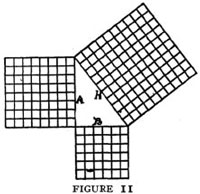
So it makes sense, on the surface, we would look to Euclidian mathematics as operative Masons. So, lets first take a look at what the 47th Proposition states mathematically:

In right angled triangles the square on the side subtending the right angle is equal to the squares on the sides containing the right angle. Using this formula, we can prove a circle and a right angle, a square and much more, all of which are essential for the operative mason. This formula is essential in any construction effort, hence is obvious importance to operative masons.

But, we are not operative masons, we are speculative only. That being the case, why is the 47th Problem of Euclid important to us? Or is it?

Anderson's “Constitutions” published in 1723, mentions

“The Greater Pythagoras, provided the Author of the 47th Proposition of Euclid's first Book, which, if duly observed, is the Foundation of all Masonry, sacred, civil, and military…” and in the Third Degree lecture: “This wise philosopher (Pythagoras) enriched his mind abundantly in a general knowledge of things, and more especially in Geometry, or Masonry. On this subject he drew out many problems and theorems, and, among the most distinguished, he erected this, when, in the joy of his heart, he exclaimed Eureka, in the Greek language signifying, "I have found it," and upon the discovery of which he is said to have sacrificed a hecatomb. It teaches Masons to be general lovers of the arts and sciences.”
Masonry, as a speculative science concerns itself with morality, upright behavior and the brotherhood of man. Since we are speculative masons, there must be a more significant reason for the 47th Problem of Euclid, a meaning within a meaning. The thinking man must ask himself, what relationship does geometry (the square is an emblem of truth and morality) have to morality that it would be an emblem of morality?

The answer is right before us, but as with all things Masonic, one must go back to the foundation. At the time the first grand lodge was founded, the 47th problem of Euclid was more commonly known as the Pythagorean Theorem. So why did those early ritualists chose to use the 47th Problem of Euclid?

First, it was not Pythagoras who discovered the rule that is referenced by his name. The Egyptians used this principle long before Pythagoras set it down to measure their fields after the annual Nile floods washed away the boundary markers. Pythagoras is the man who proved that the process works.


History records that Pythagoras established a society with philosophical, religious and political aims. Shrouded in secrecy, they believed that only by truly understanding the universe could one achieve salvation of the soul, and as Divinity created all things, studying it over a period of several lifetimes, could bring one closer to Divinity itself. As such, it was believed that through study and reason could one start to understand Divinity. Clearly, reason is based on measurable things (such as through numbers and objects), and is easier to understand if expressed in that matter by a larger number of people.


Hence the society devoted much of its time to the mathematics, including Geometry to try to explain and express matters using numbers. Being able to explain many unknowns using reason (and numbers) was incorporated in Freemasonry, which sets it opposite to the Church, which emphasizes faith over reason. Indeed, Pope Pius IX, in his encyclical, Qui Pluribus, dated 9 November 1846, attacked those who “put human reason above faith, and who believe in human progress.” Many people consider this to be a reference to Freemasonry.


This is interesting, because in the Book of Wisdom 11:20 we read:
Even apart from these, men could fall at a single breath when pursued by justice and scattered by the breath of thy power. But thou hast arranged all things by measure and number and weight.
So the very “measurement of things” the Church objects to is mentioned in Scripture as being a universal "standard" that allows men to understand their world and their surroundings.

Geometry is about measuring and creating standards, understanding and reasoning. These things were opposed by the early church leaders, so it is understandable that Freemasonry, as a bastion of reasoning and moral philosophy would conceal its secrets within geometry.

This still leaves us with the question, “Why the 47th Problem of Euclid and not the 1st or the second? The reason it was chosen was to conceal the greater truth!

In the 18th century, there was another philosopher, a moral philosopher, who presented his moral philosophy in the same format that Euclid used to present his geometrical problems. More than that, he titled his book: “Ethics,” and based his ethics upon the format used by “Euclid” to present his mathematical formulas. This philosopher was Benedict Spinoza (1632-1677), and strangely enough, the 47th Problem:

PROP. XLVII. The human mind has an adequate knowledge of the eternal and infinite essence of God.

Jeff Peace once wrote me:

When you consider that the early speculative Freemasons considered Freemasonry to be "a peculiar system of morality veiled in allegory and illustrated by symbols," it seems logical to conclude that hidden somewhere within the Masonic system lay hidden a system of morality that was peculiar (unique).

Slightly before speculative Freemasonry appeared on the scene a famous philosopher wrote a book of ethics (morality) that was truly peculiar (unique), it was so unique that he was labeled a heretic and copies of his book were burned. His book was peculiar in more ways than just his ideas, it was written in the same format as Euclid’s "Book of Elements," it was a moral philosophy based on the logical format of Geometry.

Freemasonry is about morality, and the 47th problem of Freemasonry is about morality… Masonic symbolism is the building of a moral edifice… perhaps the two Euclidian problems, having the same name, influenced the use of the symbol of geometry to represent both… mathematics and morality.

Just something else to think about.

May the blessings of heaven rest upon us and all regular masons, may brotherly love prevail, and every moral and social virtue, cement us.

Thursday, October 4, 2007

Grand Lodge of California 2007 Communication

Here is the results of the issues balloted upon and the results of the voting at the Grand Lodge of California, F&AM this year:

GM 2007 Decision #1

* Membership in Snakes -- The Grand Lodge was asked if they felt the snakes are not a valid Masonic organization is as much as they have not submitted their Constitution and Bylaws to the GL of CA as required. The Membership agreed with the Grand Master. Affirmed

GM 2007 Recommendation #1

Deadlines on Weekends or Holidays -- Extending Deadlines that fall on a weekend day or holiday to the next legal work day following Passed

Carry-Over from 2006:

* GM2006-01: Reducing 5/6 to 3/4 for Adoption of Legislation Failed
* 06-03: Lodge formation (only need 15 instead of 25) Passed
* 06-05: Forfeiture of Fees -- EAs and FCs who have let 3 yrs or more elapse since they received their last degree, will forfeit the "petition costs". The still stay on the rolls, unless they write a letter of demit. Should they in future, the will pay the costs of conferring the last of their degrees. Passed
* 06-09: Formulation of Annual Dues of constituent Lodges -- Giving the Lodges the ability to round UP, to the nearest unit (half-dollar, dollar, five dollar, etc), with respect to the Per Capita charges by GL. Example: if GL post Per Capita of 15.23, the lodge could make the change to the members dues 16.00, if the wish. It's the lodge's choice to do or not to do. Passed


Resolutions for 2007

* 07-01: Allow Inspectors to vote at Annual Communication Carry-over
* 07-02: Past Master's title when serve consecutive terms -- Past Master's is regarded as a Past Master even if the succeeds himself in the Office of Master Passed
* 07-03: Grand Treasurer's report at Annual Communication -- Grand Treasure shall give an unaudited Treasures' report from as of July 31st of the current year: Passed
* 07-04: Qualification procedures for Past Master -- Brethren who have been MASTER within the past 6 years don't have to qualify again Failed
* 07-05: Conviction of a crime of moral turpitude Withdrawn
* 07-06: Early presentation of Golden Veteran awards Passed
* 07-07: Foreign degree conferrals -- Brothers from other states, and our brothers in other states, can be conferred the FC and MM degrees, with approval of both Grand Masters of the subject states. Passed

There were 1,168 attendees, which was more than last year by 8%. There were 337 lodges in Attendance or 89%, which is wonderful. One lodge was moved from Dispensation to receiving a charter: the lodge created at the Covina Masonic Homes

Wednesday, October 3, 2007

The Middle Chamber

Warning: The following discusses non-ritual symbolic issues related to the second degree of masonry.
Brethren, friends all;

The second degree of Freemasonry speaks of the Middle Chamber of King Solomon’s Temple, how a Mason gets there, and what is done with him when he arrives. Allegorically, this is on the second floor of King Solomon’s Temple, where a brother arrives after ascending flights of stairs. The surface symbolism of these stairs is explained to the candidate… at length.

The symbols of the second degree, especially the description of the symbolism of the stair, is highly allegorical, bearing only a very surface resemblance to what the candidate is told. In this short article, the author is not going to dissect the symbols and explanations given to the candidate on his journey. Instead, we will focus our attention on the destination.

The Middle Chamber of King Solomon’s Temple

The candidate is told that the middle chamber is on the second floor of the temple, and is a place where the Fellows of the Craft met and held their lodges. He is told that is where they had their names recorded, and received their wages. This is the first time a candidate is told about receiving wages, and it is an important step for him.

What is the Middle Chamber though? To understand, we need to look at what King Solomon’s Temple Symbolizes. In the Entered Apprentice Degree, that candidate is told that

“…on your return to the temple, you are placed in the north-east corner thereof, that you might be near the worshipful master, to receive instruction from him, whereby you may be able to erect your future, moral Masonic superstructure.”
The candidate is also told that by the use of the common gavel, he is to work on perfecting his imperfect ashlar, himself, that he might remove all the rough and superfluous parts of the stone, thereby fitting our minds (spirits) as LIVING STONES, in that spiritual building, that house not made with hands, eternal in the heavens.

The symbolic temple we are building, perfecting, is ourselves. WE are King Solomon’s Temple, that perfect structure ready to house the spirit of g-d. The middle chamber is therefore within US.

Why do we make an ascent from the outer portico, though a long aisle or porch, up a set of stairs to the middle chamber? Lets look at the symbology of the degrees again.

The Entered Apprentice symbolizes youth, infancy, entry. This degree is also the material, the base, the foundation of Freemasonry. It is the doorway… the portico INTO the temple.

As we enter the temple, we begin to learn. We expand the mind by experience and study. The first two flights of stairs introduce us to fundamental concepts, expanding on what we received in the first degree. Note that there are THREE flights of stairs, and the first concept we are introduced to on our way UP the stairs is the number three.

When we arrive at the third set of stairs, we are faced with the Quadrivium: Grammar, Rhetoric, Logic and Arithmetic; and the Trivium: Geometry, Music, and Astronomy. These are intellectual pursuits, the pursuits of the maturing mind. This makes sense, as the Fellowcraft degree is the degree of maturing, of developing skill.

Where the Entered Apprentice is the material, the foundation, the Fellowcraft is the mind, rising above the material, between the material and the spiritual. The fellowcraft IS the middle chamber, between the ethereal and the material.

As we ascend the stairs, we ascend, symbolically, Jacobs Ladder, the three principle rounds of which are faith, hope and charity. As an aside, we speak of charity in the first degree, but the more correct translation of the Aramaic is actually LOVE, as in Agape Love. Charity is, more accurately, disinterested fellowship, or the spiritual love of one’s fellows.

As we consider the THREE principle rounds of the staircase in the fellowcraft degree, we should also consider that as Jacobs ladder is a symbol of this staircase, a more accurate translation of the Aramaic story of Jacob’s Ladder is that of a STAIR. The angels were ascending and descending a stairway whose foot was on the earth, and whose head was in the heavens.

In ancient times, the heart was seen as the seat of the mind, the soul or spirit, not the brain. When the ritual speaks of the middle chamber, it speaks of the mind, of the soul of the man.

When we start off at the foot of the stairs, we are reminded of the significance of three, and on the second landing, the symbolism of the second degree is emphasized, and on the third landing, we are shown the importance of learning, maturity, cogent thought. Then, after the symbolism is well set in our minds, we are admitted to the middle chamber of King Solomon’s (OUR) Temple.

Upon our first admission (!!) to the middle chamber, we are presented two very important new symbols: Wages of a Fellowcraft Mason and the three precious Jewels of a Fellowcraft Mason. Again, this paper is not the place for a lengthy dissertation on those symbols, suffice it to say that they emphasize and expand on what we have already been presented.

As Fellowcrafts, we have ascended Jacob’s Ladder, from the material level to the middle, or mental level of our lives, and more importantly, our way of thinking and viewing the world. We are yet one material step away from opening our minds to the true secrets of a Master Mason, and after due contemplation of the lessons of this degree, we will be considered as candidates for the Sublime Degree of Master Mason.


May the blessing of heaven rest upon us and all regular masons, may brotherly love prevail, and every moral and social virtue, cement us.


Sunday, September 30, 2007

What is an Egregore?

Before starting, the author would like to express thanks to Wr. Giovanni Lombardo for his assistance in defining and bringing this article to the readers.

If you have never heard of the term “egregore”, join the crowd. Many people have never heard the word, and until recently, that crowd INCLUDED the author. A year ago, while on The Lodgeroom US, a fervent antimasonic… person, named Thomas “Skip” Sampson, tossed out an unsupported and off topic slander to the effect that we masons should go back to working on evoking our egregore in lodge.

At the time, the author was stunned, never before having heard the word. A quick internet search revealed nothing, and not having any information on the subject, a research project was born, and thence this paper.

At the time, very little was available, though that has changed recently. One of the problems is that egregore is spelled two different ways, with a “E” at the end, and without. This made is difficult at first to find information.

So, what is an egregore, and how does it relate to freemasonry?

Let start with a simple explanation of what an egregore is, or is reputed to be, and then move on from there. On this subject, there are various opinions, especially among “occultists” who seem to be the primary authors on the nature of the egregore. Following are the four primary occultist definitions:


An energized astral form produced consciously or unconsciously by human agency. In particular, (a) a strongly characterized form, usually an archetypal image, produced by the imaginative and emotional energies of a religious or magical group collectively, or (b) an astral shape of any kind, deliberately formulated by a magician to carry a specific force.[1]

…from a Greek word
meaning “watcher.” A thought-form created by will and visualization. A group egregore is the distinctive energy of a specific group of magicians who are working together, creating and building the same thought-form or energy-form.[2]

Any symbolic pattern that has served as a focus for human emotion and energy will build up an egregore of its own over
time, and the more energy that is put into such a pattern, the more potent the egregore that will form around it. The gods and goddesses of every religion, past and present, are at the centers of vast egregore charged with specific kinds of power. This power is defined by, and contacted through, the traditional symbolism of the deity in question.[3]

An egregore is an angel, sometimes called watcher; in Hebrew the word is ir, and the concept appears in The Book of Enoch.... Thus, Irim, the city of the Nephilim is again linked with the Book of Enoch, since the Nephilim, according to that Book, were the sons of the Irim (the egregores.)....Although the Irim, the egregores, are angels on both sides of the camp - fallen angels as well as faithful ones.[4]


René Guénon, a prolific writer on Masonic philosophy offers the following:

First of all, we must point out that we have never used the word ‘egregore’ to designate what could properly be called a ‘collective entity’; the reason for this is that the term is wholly untraditional and only represents one of the fantasies of modern occultist language.

The first person to use it (egregore) this way was Eliphas Levy, and if our memory is exact, it was he who, to justify this meaning gave it the improbable Latin etymology, deriving it from grex, ‘flock’, whereas the word is purely Greek and has never signified anything more than watcher.[5]


It appears therefore that, according to Guénon that an egregore is a manifestation of psychic energy, as opposed to a spiritual force as the occultists would define it. Now that the author has completely confused you, let us proceed to dissect what we have as “definitions” to see if we can come to an understanding of the egregore, and its “place” in freemasonry.

Of the definitions offered, that of Guénon seems to be the one that actually relates to masonry, while the others relate to religious/occult faith. The egregore is a psychic entity, existing between the material and the spiritual, in contact with both. It is the creation of the psychic will of the members of a group, and exists as a connection to the divine.
As we work rituals, the focused mental energy creates and invokes the egregore to fulfill the need of the group. An egregore is not a magical creature, it is not self aware, and is not a Djin, to carry out wishes. The egregore serves as a conduit, a nexus, to connect the group that created/invoked it to the spiritual.

Some egregores are temporary, while some, like the egregore of a lodge, a church, or a country, are the result of the continuous will that creates them, and this will also sustains them. The egregore of freemasonry has existed for centuries, and is the result of the focused will to connect with the spiritual from millions of men.

An egregore is the psychic “entity”. All members of a group, whether it is a club, your family, your lodge, a faith, a political party, a country, or even a single person, are united with the egregore of that group through a psychic connection. As a result, and given the nature of society, we are often included in the sphere of several egregores at once.

The strength and ability of the egregore to aid and assist the members of the group grows over time and through numbers, by drawing support from the members constituting it and through their repeated actions maintain its power. The egregore, in turn, invokes the immaterial and raises us from the material, connecting us to the subtle worlds.

Where the intent is positive and spiritual, the effect of the egregore consists in conveying spirituality to the members as in the initiatic process of the lodge. The intent is to divest the candidate of the profane and connect him to the spiritual, and for most masons, that effect is felt and received most profoundly. To the contrary, in the case of other groups, especially the counter-initiatic ones – which adopt rites and symbols to attain profane or negative goals – the egregore can be quite destructive to the lives and spirits of those members.[6]

Each individual who is involved in a group is influenced by these egregores. For those that reach for a spiritual connection, the egregore assists and facilitates that connection. This process is unconscious, but is intensified through the initiatic process, which is designed to open the mind to the spiritual through the egregore.

A symbolic representation of this may be had in the examination of the Star of David, an emblem of the divine. The top triangle points the heavens, and to the spirit. The bottom triangle points down, to the material and profane. United, they form a new entity, the six-pointed star that represents the unity of the two, from material to the spirit, connection to the divine.

An example of this we are familiar with in Freemasonry is the Compasses and Square. The compass represents the male, the spiritual energy, while the square represents the material. The compasses enclose and define the spiritual, as in the point within a circle, while the square defines the mortal, the material world. United, these two symbols, like the triangles, which form the Star of David, an emblem the represents the divine, so, too, does the square and compasses united, represent the divine, as is shown by the letter G in the middle.

So, the nature of the egregore has been known since time immemorial, as shown above. Its function is that of a guide, and intercessory, to conduct the group members to the spirit and connect them with it. Some groups are connected more powerfully from the profane and mortal side to the spiritual than others, some less so, but to each group according to its intent. As with all things, it is the intent that matters, not the form.

Guénon goes on to state, in reference to the egregore’s influence:

Man has, however, to point out that the Egregore “can never transcend the individual domain since, in the final analysis, it is only a resultant of the component individualities, nor, consequently, can it go beyond the psychic order; now all that is, only psychic can have no effective and direct relationship with initiation since this latter consists essentially in the transmission of a spiritual influence meant to produce effects of a similar spiritual order, thus transcendent with respect to the individuality, whence one obviously must conclude that whatever is able to render effective the initially virtual action of this influence, must itself necessarily have a supra-individual and thus, if one may put it so, a supra-collective character.”[7]

In a lodge of freemasons, the egregore is strengthened by time and experience, and the will and intention of good men. The strength of the egregore is patent in the effect the ritual has on the candidate, and effect that cannot be accounted for simply in the execution of the ritual itself.

We have all experienced the thrill, the exhilaration of the initiation, and the emotional high that carries us for days afterward as the flame is kindled in our breast. This is the spirit the egregore connects us with that fills us and carries us. It is this spirit that breathes in us, inspires us with brotherly love, relief, truth and charity.

The spirit is from the divine. The egregore is the psychic link between the mortal to the spirit. The mason is inspired by the breath of the spirit.

And thus: freemasonry.

References


1 Planetary Magick, Denning & Phillips, (Llewellyn Publications)
2 Golden Dawn Glossary http://www.thelemicgnosticism.org/aa/contacts.htm
3 John Michael Greer, from: Inside a Magical Lodge
4 Egregore by L.S. Bernstein, http://www.crcsite.org/egregor.htm
5 Spiritual Influences and Egregores by René Guénon, in Initiation and Spiritual Realization, Sophia Perennis, Hillsdale, N. Y. p37, paragraph 2
6 So it was in some Nazi esoteric groups, such as Thule or Vril. Also http://www.harare.unesco.org/hivaids/webfiles/Electronic%20Versions/malawi%20lifeskills.doc
7 Spiritual Influences and Egregores by René Guénon, in Initiation and Spiritual Realization, Sophia Perennis, Hillsdale, N. Y. p119


May the blessings of heaven rest upon us and all regular Masons, may brotherly love prevail, and every moral and social virtue, cement us.


/* Blog Catalog Code ----------------------------------------------- */ Philosophy Blogs - BlogCatalog Blog Directory /* End Blog Catalog Code ----------------------------------------------- */